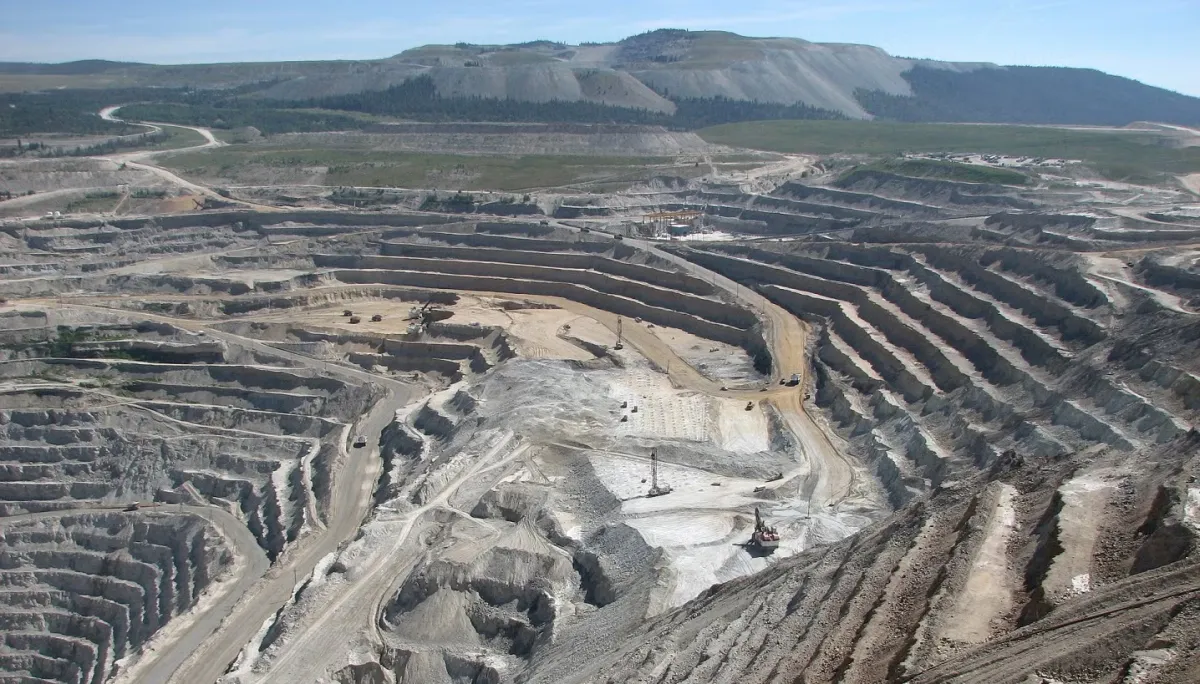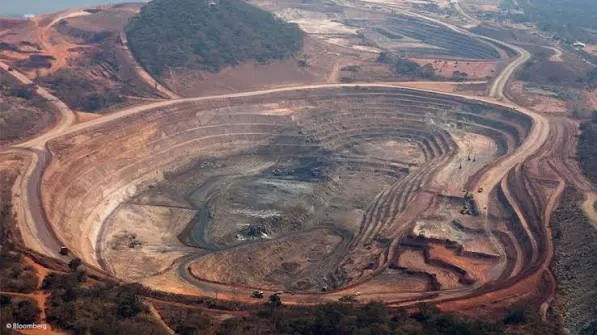
Uranium occurs naturally alongside copper and cobalt in parts of the Congolese Copperbelt. Whether it reaches an exported cobalt product depends on the mineralogy of the ore, the chemistry of the processing circuit and whether the operator has installed a dedicated uranium-removal stage.
The presence of uranium in cobalt exports does not necessarily begin with misconduct at a border or an undeclared uranium-mining operation. It can begin much earlier, in the geological formations from which copper and cobalt are extracted in southern Democratic Republic of Congo.
Parts of the Central African Copperbelt contain uranium, copper and cobalt mineralisation within or close to the same geological formations. When uranium-bearing material enters a copper-cobalt processing plant, its eventual destination depends on how it behaves through crushing, acid leaching, impurity removal and cobalt precipitation.
Without a dedicated removal process, some uranium may remain in the cobalt-bearing solution and eventually report to crude cobalt hydroxide. Other portions may be transferred into tailings and processing residues.
This is the technical pathway at the centre of the current dispute over uranium in Congolese cobalt exports.
It starts with the geology
The Central African Copperbelt extends through southern DRC and northern Zambia. The United States Geological Survey describes it as the world’s largest sediment-hosted copper-cobalt province, with more than 80 identified deposits in the geological area assessed.
Many economically important Congolese cobalt deposits occur in rocks belonging to the Roan Group. These formations can contain elevated uranium background levels as well as discrete uranium mineralisation near copper and cobalt deposits.
Uranium is not distributed evenly throughout the Copperbelt. Its concentration can vary considerably between deposits, mining areas and individual sections of the same ore body.
This variation is important. Results from one mine, plant or export shipment cannot automatically be applied to the entire Congolese cobalt industry.
In oxidised ores, cobalt is commonly associated with heterogenite, a cobalt oxyhydroxide mineral. Research cited in the recent Nature Communications study indicates that heterogenite can incorporate oxidised uranium species into its mineral structure.
This close mineral association makes early physical separation difficult. If uranium and cobalt occur within the same mineral grains, crushing and conventional ore concentration will not necessarily divide them into separate streams.
Step 1: Crushing and physical concentration
After extraction, ore is crushed and ground to liberate valuable minerals from the surrounding waste rock.
Physical separation methods can then increase the concentration of copper and cobalt by rejecting material with little economic value. Depending on the operation, these methods can include washing, screening, dense-media separation or other gravity-based processes.
These stages are effective when the valuable mineral and unwanted material have different physical characteristics.
They are less effective when uranium is chemically or structurally associated with the same oxidised minerals carrying cobalt. In that situation, uranium can follow cobalt into the upgraded ore rather than being discarded with the waste rock.
The result depends heavily on the ore’s mineralogy. A plant processing material with low background uranium may face little difficulty, while another treating uranium-enriched sections of an ore body may receive a significantly different feed.
Step 2: Sulphuric-acid leaching
Much of the cobalt recovered from oxidised Copperbelt ores is processed hydrometallurgically.
The upgraded ore is mixed with sulphuric acid, which dissolves copper, cobalt and other soluble elements into a liquid known as the leach solution.
The recent Nature Communications paper notes that at the strongly acidic conditions commonly used during leaching—around pH 1.5—oxidised uranium species are highly soluble.
This means uranium present in the feed may dissolve alongside cobalt instead of remaining in the solid residue.
At this point, uranium is no longer simply a mineral particle that can be removed through screening. It is present as a dissolved species within a chemically complex process solution.
Step 3: Copper is recovered first
Copper is generally recovered from the leach solution before cobalt.
Solvent extraction is used to transfer copper selectively into a separate liquid phase before it is recovered, often through electrowinning.
The remaining solution still contains cobalt and a range of impurities. Depending on the ore and process conditions, dissolved uranium may also remain in this cobalt-bearing stream.
Copper solvent extraction is designed primarily to recover copper. It should not be assumed to provide complete uranium removal unless the circuit was specifically designed and operated for that purpose.
The uranium pathway therefore continues into the stages used to purify and concentrate cobalt.
Step 4: Conventional impurity removal captures only part of the uranium
Before cobalt is precipitated, plants normally remove impurities such as iron, aluminium and manganese. This is often described as the FAM-removal stage.
Lime or another neutralising reagent is added to raise the pH. The targeted impurities form solid hydroxides or oxides that can be separated from the liquid and directed to a residue or tailings stream.
Some uranium may be removed incidentally during this stage through precipitation or adsorption onto the newly formed solids.
The removal is unlikely to be complete.
According to the chemical model used in the Nature Communications paper, a single low-pH FAM stage may remove less than 10% of the dissolved uranium. A second stage at a higher pH could remove more, although the exact performance will depend on the plant, solution chemistry and operating conditions.
The technical difficulty is that uranium precipitation becomes more effective as the pH rises, but cobalt also begins to precipitate at higher pH.
An operator attempting to remove uranium through pH adjustment alone may therefore begin losing cobalt—the product the plant is designed to recover.
This creates an economic and metallurgical trade-off. Raising the pH can increase uranium removal, but it may also reduce cobalt recovery and transfer valuable cobalt into the residue stream.
Step 5: Dedicated uranium removal
More selective removal requires an additional treatment stage designed specifically for uranium.
A technical paper presented at the Southern African Institute of Mining and Metallurgy’s Copper Cobalt Africa conference in 2023 identified phosphate precipitation and ion exchange among the available technologies for removing uranium from cobalt-bearing process solutions.
Phosphate precipitation
A phosphate reagent can react with dissolved uranium to form a less-soluble compound. The resulting solid can then be separated from the cobalt-bearing liquid.
The process must be carefully controlled. Reagent dosage, pH, retention time, solution composition and solid-liquid separation all influence performance.
It also creates a uranium-bearing residue that must be characterised, stored and managed safely.
Removing uranium from the liquid does not eliminate it. The process transfers uranium into another material stream requiring appropriate control.
Ion exchange
Ion-exchange technology uses a specialised resin to capture selected dissolved ions from the process solution.
An appropriately selected system can remove uranium while allowing most of the cobalt to remain in solution. The uranium is subsequently stripped from the resin into a smaller, more concentrated stream for further treatment or disposal.
A commercial case study reports the commissioning of a continuous ion-exchange installation at a Congolese cobalt-processing operation in 2019. According to the technology provider, the plant was designed to treat approximately 20,000 cubic metres of cobalt-rich solution per day.
The existence of removal technology demonstrates that uranium in a cobalt circuit is a manageable metallurgical problem. It does not demonstrate how widely such systems are installed or how effectively every plant operates them.
Step 6: Cobalt-hydroxide precipitation
After copper and unwanted impurities have been removed, the plant raises the pH again to precipitate cobalt from the purified solution.
The cobalt forms a solid hydroxide product, which is filtered, washed and prepared for export.
Crude cobalt hydroxide is an intermediate product rather than refined cobalt metal or a high-purity battery chemical. It can contain residual moisture and various impurities depending on the feed material and the performance of the purification circuit.
The Nature Communications study states that cobalt hydroxide can be approximately 50 to 100 times more concentrated in cobalt than the original ore. If uranium remains in the process solution and follows cobalt during precipitation, it may also become concentrated in the final hydroxide product.
This does not mean cobalt hydroxide inevitably contains excessive uranium. The concentration will depend on:
- The uranium content and mineralogy of the original ore
- The proportion of oxidised and sulphide material in the feed
- Ore blending practices
- Acid-leaching conditions
- The number and effectiveness of impurity-removal stages
- Whether a dedicated uranium-removal system is installed
- Reagent dosage and pH control
- Washing and filtration performance
- The specifications applied to the final product
Two plants processing different ores—or the same plant processing changing sections of an ore body—may produce materially different results.
Where does the removed uranium go?
Uranium that does not enter the cobalt product must report somewhere else in the circuit.
It may remain in unprocessed waste rock, be retained in leach residues, precipitate with iron and other impurities, or be captured in a dedicated uranium-removal stage.
These materials may ultimately be deposited in tailings or stored as a separate residue.
The IAEA classifies radionuclides of natural origin contained in ores, products, by-products and processing residues as naturally occurring radioactive material, or NORM. Mining and chemical processing can redistribute these radionuclides and increase their concentrations in particular product or waste streams.
The presence of NORM does not automatically mean a material presents an unacceptable risk. Regulation should be proportionate to its radiological characteristics and the possible exposure pathways.
For tailings and residues, the relevant questions include:
- What radionuclides are present?
- At what activity concentrations?
- In what chemical and physical form?
- Can the material generate contaminated dust?
- Can uranium migrate into surface water or groundwater?
- Are workers or communities regularly exposed?
- How stable is the storage facility over the long term?
The IAEA recommends an integrated and graded regulatory approach to managing NORM residues, with controls proportionate to the measured risk.
Concentration is not the same as exposure
Discussions about uranium in cobalt frequently cite concentrations expressed in parts per million. This measures the mass of uranium present in a material.
Radiation-protection decisions also use activity concentration, commonly measured in becquerels per gram, and estimates of the dose that workers or members of the public could receive.
A uranium concentration expressed in parts per million cannot, by itself, establish the level of exposure experienced by a worker or community.
Risk also depends on factors including the uranium isotopic composition, associated decay products, dust generation, radon, ventilation, ingestion or inhalation pathways, exposure duration and the effectiveness of protective controls.
The IAEA notes that NORM in industrial processes may require regulation and monitoring when activity concentrations or exposure conditions exceed relevant criteria. It does not treat every mineral containing natural uranium as presenting the same level of risk.
This is why chemical assays, radiological measurements and exposure assessments must not be treated as interchangeable.
What the recent study establishes—and what it estimates
The Nature Communications paper provides a technically plausible pathway for uranium to move with cobalt from oxidised ore into crude cobalt hydroxide.
It draws on known geology, mineral chemistry, processing behaviour, production information and trade data.
However, its estimate that between 2,000 and 5,000 tonnes of uranium may have been exported from the DRC between 2000 and 2024 is based on a first-order carryover model. It is not the result of direct testing of every cobalt-hydroxide shipment over that period.
The model’s output depends on assumptions about uranium concentrations in ores, differences between mining operations, processing configurations and the proportion of uranium removed or transferred to tailings.
The study therefore identifies a credible mechanism and a potentially material oversight issue. It does not provide a shipment-by-shipment record or establish that every producer exported cobalt containing uranium above applicable limits.
What the DRC investigation must test
The Congolese government has ordered a representative testing campaign involving national institutions and an internationally accredited laboratory.
To produce meaningful results, the investigation will need to account for the geological and operational variability across the industry.
A technically credible programme should disclose:
- How mines, plants and shipments were selected
- The number and timing of samples
- Whether sampling occurred before or after product blending
- How sample integrity and chain of custody were protected
- Whether results are reported on a wet or dry basis
- Which analytical methods and detection limits were used
- The uranium concentration and radiological activity detected
- The standards used to determine compliance
- Whether tailings, process residues and workplace exposure were also assessed
- Whether participating plants have dedicated uranium-removal systems
A single round of testing can provide a snapshot. It may not capture changes caused by ore variability, mine sequencing, maintenance conditions or adjustments to the processing circuit.
If Kinshasa wants to establish long-term confidence, the investigation may need to lead to routine risk-based monitoring rather than a one-time verification exercise.
The central technical question is not whether uranium exists in the Copperbelt. That is already established. The question is how much enters each processing circuit, where it moves during treatment, what reaches the exported product and whether the remaining material is managed safely.
Only direct, independently verifiable measurements can answer that question for individual operations and shipments.
Principal technical sources
- Nature Communications: Uranium in cobalt-hydroxide exports from the Democratic Republic of the Congo
- USGS: Sediment-hosted copper assessment of the Roan Group in the Central African Copperbelt
- SAIMM: Uranium Removal from Cobalt Process Liquor
- IAEA: Naturally occurring radioactive material
- IAEA: Management of residues containing NORM
- IAEA: Occupational radiation protection in uranium mining and processing