Zambia is attempting to redefine the state’s role in mining without returning to full operational control of the industry.
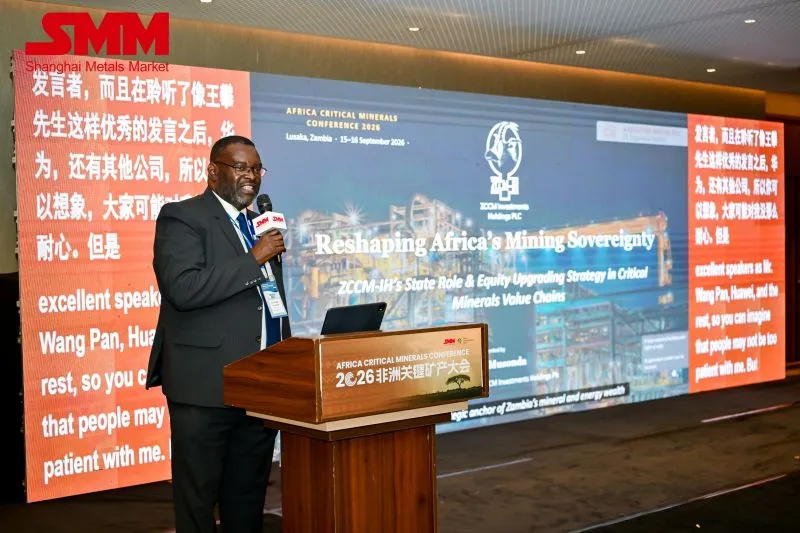
Speaking at the SMM Africa Critical Minerals Conference in Lusaka, ZCCM Investments Holdings Chairperson Phesto Musonda presented a model based on strategic equity, more predictable investment income and greater domestic participation across mineral value chains.
The argument is that Zambia should no longer measure success only by the tonnes of copper extracted. It must also consider the income retained by the state, the goods produced locally, the skills transferred to Zambian workers and the country’s participation in processing, trading and manufacturing.
That ambition places ZCCM-IH at the centre of a difficult balancing act: securing a larger national share of mining value while maintaining the policy stability and private capital required to expand production.
From passive shareholding to strategic equity
ZCCM-IH holds interests in nine copper assets, including 49% of Mopani Copper Mines, 30% of Lubambe, 20.6% of Konkola Copper Mines and 20% of Kansanshi. Its portfolio also includes stakes in Mingomba, CNMC Luanshya Copper Mines and NFC Africa Mining.
The company’s emerging strategy combines equity ownership with instruments intended to produce more reliable returns. At Kansanshi, for example, ZCCM-IH replaced its previous dividend-dependent interest with a revenue-based royalty arrangement. The company says this generated $137 million between 2022 and the first half of 2025, including during years in which Kansanshi declared no dividends.
This matters because minority state shareholders can own valuable stakes without receiving predictable cash when operators retain earnings to finance expansion. Royalties provide earlier and more regular income, although they can also reduce the state’s exposure to the larger upside available through conventional equity.
ZCCM-IH is nevertheless increasing its ownership where it considers the asset strategically important. Its June 2026 investor presentation indicates that its interest in the Mingomba copper project, being developed with KoBold Metals, is expected to rise from 20% to 25%. The project is being designed for eventual annual capacity of between 300,000 and 500,000 tonnes. ZCCM-IH investor presentation
At Mopani, the state company retained 49% after International Resources Holding acquired a controlling interest and committed new capital. The operation is targeting production of 220,000 tonnes by 2027. Rather than operating Mopani alone, Zambia retained substantial ownership while bringing in an external investor to provide finance and technical capacity.
This is the practical meaning of ZCCM-IH’s “equity upgrading” strategy: the state does not need to own every mine outright, but it wants stronger positions in selected assets and investment structures that deliver measurable returns.
Three million tonnes requires more than ownership
Zambia produced 890,346 tonnes of copper in 2025, up from 821,000 tonnes in 2024. Reaching the government’s target of three million tonnes by 2031 would therefore require production to grow to more than three times its current level within six years.
The project pipeline is substantial. It includes the expansion of Kansanshi, the recapitalisation of Mopani and Konkola, the reopening of Shaft 28 at Luanshya, the development of Mingomba and additional investment at NFC Africa Mining.
International investors have announced more than $12 billion in mining commitments since 2021, including approximately $2 billion for Barrick’s Lumwana expansion and $1.1 billion associated with the Mopani transaction. But announced capital must still be converted into completed shafts, processing facilities, electricity connections and actual production. Financial Times
Power represents one of the largest constraints. Mining already accounts for approximately 45% of Zambia’s electricity consumption, while sector demand is increasing. ZCCM-IH estimates that between 150 MW and 200 MW of additional capacity may be needed annually to keep pace with the production programme.
Transport capacity, mine-development timelines and exploration expenditure will create further limits. Zambia’s new regulatory institutions may improve licensing and dispute resolution, but only if they shorten approval periods and apply rules consistently.
The establishment of the Minerals Regulation Commission and a Mining Appeals Tribunal is intended to separate technical regulation from direct ministerial administration. For investors, the value of these institutions will not lie in their creation alone, but in whether they produce transparent licensing decisions and a credible mechanism for challenging them. Zambian Parliament
Local content must become industrial capacity
Zambia’s local-content policy is also moving beyond procurement percentages. The government wants mines to purchase more goods and services from Zambian companies, but the longer-term objective is to develop domestic manufacturing, processing and technical capabilities.
The distinction is important. Replacing an imported supplier with a locally registered distributor may increase domestic procurement figures without creating substantial industrial value. Localisation becomes economically meaningful when equipment components, chemicals, engineering services and intermediate mineral products are produced within Zambia.
The government’s 2026 local-content guidelines provide a framework for increasing the participation of Zambian suppliers. Their success will depend on whether domestic companies can access finance, meet mine-level safety and quality requirements and deliver consistently at the scale demanded by expanding operations. Ministry of Mines and Minerals Development
ZCCM-IH’s strategy therefore involves more than accumulating shares. The company wants to use its positions across mining, power, exploration and commodities trading to capture value at several points in the industry.
The commercial test will be visible in a limited number of outcomes: whether copper production approaches the 2031 target, whether ZCCM-IH generates reliable returns from its portfolio, whether local suppliers become manufacturers rather than intermediaries, and whether new regulation accelerates investment instead of adding another administrative layer.