South Africa’s attempt to attract Chinese investment into a R2.2 trillion electricity programme could have consequences well beyond the energy sector. If implemented, the generation and transmission projects presented in Beijing could remove one of the principal constraints facing mines, smelters and mineral-processing facilities: access to reliable and affordable electricity.
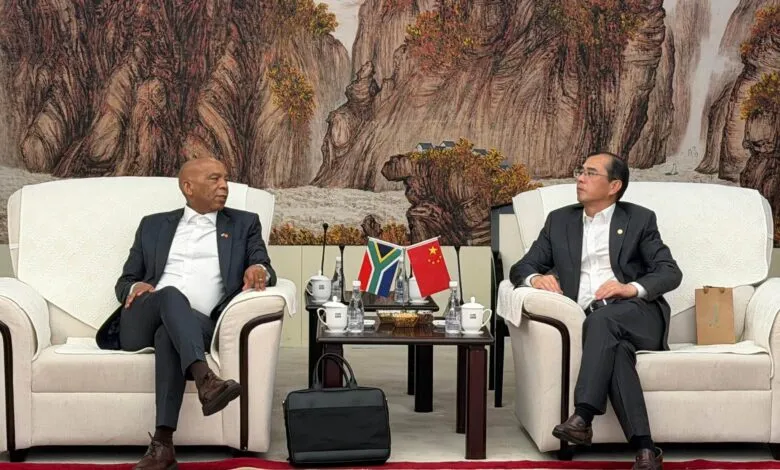
Electricity and Energy Minister Kgosientsho Ramokgopa is leading a government and business delegation attending the South Africa–China Electricity and Energy Investment Conference from 2–6 August. The delegation includes representatives from Eskom, development-finance institutions and other public bodies.
The investment proposition is based on South Africa’s Integrated Resource Plan 2025. It provides for approximately 105 GW of additional generation capacity and about 14,500 kilometres of transmission lines through 2039.
Ramokgopa said Chinese companies had made firm commitments to participate in the programme. However, the identities of all participating companies, the value of their individual commitments and the proposed financing structures had not been fully disclosed at the time of the announcement.
This distinction is important. Expressions of interest and corporate commitments do not yet constitute financed power stations, transmission lines or manufacturing plants.
The grid problem facing mining
South African mining companies have responded to electricity shortages and rising tariffs by developing or procuring renewable power. Regulatory reforms have enabled private generators to supply mines through wheeling arrangements, under which electricity produced in one location is transported through the national grid to a customer elsewhere.
But the expansion of private generation is increasingly constrained by limited transmission capacity, particularly in areas with strong solar and wind resources. A generation project cannot supply a distant mine if the network lacks the capacity required to carry the electricity.
This makes South Africa’s approximately R440 billion transmission programme particularly relevant to mining. Grid investment could accelerate private energy projects, improve security of supply and support longer-term investment in energy-intensive activities such as smelting, refining and mineral beneficiation.
The Minerals Council South Africa has warned that reforms involving the transmission system and private-sector participation in electricity generation should not be delayed. Mining companies require predictable grid access to justify investments that may operate for decades.
Investment or import dependence?
China offers financial capacity, engineering experience and a dominant manufacturing position in solar panels, batteries, transmission equipment and other components required for electricity expansion.
For South Africa, however, the objective is not only to import equipment. The government is presenting the energy programme as part of a wider reindustrialisation strategy involving domestic production, technology transfer and employment.
The commercial terms will determine whether that objective is achieved. Chinese participation could lower construction costs and accelerate delivery, but procurement structures will need to address local manufacturing, supplier development, financing risks and dependence on imported technology.
The mining sector will judge the programme through practical outcomes: additional grid-connection capacity, shorter project delays, improved power reliability and electricity costs that allow mines and processing plants to remain internationally competitive.
South Africa has assembled a substantial investment pipeline and received preliminary backing from Chinese companies. The next test is converting those commitments into bankable projects—and ensuring that new infrastructure reaches the industrial users whose expansion depends on it.