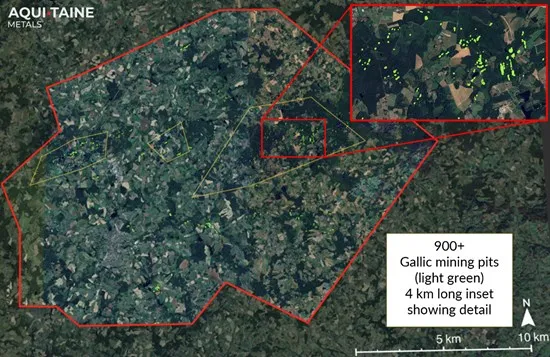
Chris Taylor, the executive who propelled Great Bear Resources into a $1.8 billion takeover by Kinross Gold in 2022, is staking his next act on a long-dormant gold district in southwestern France. His privately held Aquitaine Metals will launch drilling next month at the Limousin project, a sprawling land package near Bordeaux that Taylor claims could dwarf even his Canadian discovery.
The move marks a strategic pivot for Taylor, who stepped into Aquitaine’s CEO role last week. It also revives a region with a mining lineage stretching back to 500 BCE, when Gallic tribes extracted gold at grades exceeding 20 grams per tonne. Modern operators, including France’s COGEMA, produced over 1.3 million ounces between the 1920s and 2002 before abandoning the area during a prolonged gold price slump.
From Red Lake to Limousin
Taylor’s confidence stems from parallels to Great Bear’s Dixie project in Ontario’s Red Lake camp, where a 2018 discovery upended assumptions about a mature mining district. Kinross bought Great Bear four years later, despite no formal resource estimate, betting on a system that now holds 6.6 million ounces across three zones.
At Limousin, Taylor sees a larger prize. The 330-sq.-km property contains 200 km of gold-bearing structures—10 times Red Lake’s footprint—with historical underground grades averaging 12.5 grams gold per tonne. An initial 8,800-metre drill program will begin in February, testing extensions of the high-grade Laurieras and Moulin de Cheni mines.
“This isn’t a single deposit—it’s a district with 23 past producers and mineralization that remains open at depth,” Taylor said in an interview. “The data here is more robust than anything we had at Dixie.”
Speed and Scale
Aquitaine’s French subsidiary, Compagnie des Mines Arédiennes (CMA), fast-tracked permits in three months, a rarity in European mining. The efficiency reflects France’s push to revive domestic critical mineral production, particularly antimony—a strategic metal found alongside Limousin’s gold. China controls 80% of global antimony supply, used in flame retardants and military hardware, heightening EU interest.
Historical work bolsters the case: COGEMA’s $430 million exploration database includes 222,000 metres of drilling, with assays showing consistent high grades. Surface samples from ancient Gallic pits graded up to 80 grams gold per tonne, while 20th-century operations yielded 300,000 ounces at 20 grams gold.
Taylor’s return to exploration follows Kinross’s mixed results at Dixie. Though drilling has expanded resources, Moody’s recently called the acquisition “credit negative,” citing high development costs. Taylor sidestepped critique, noting Kinross’s 420 km of drilling since 2022 proves the asset’s heft. “Great Bear will surpass 10 million ounces—Limousin could be multiples of that,” he said.
Political Tailwinds
France’s government, eager to cut reliance on imported minerals, has backed the project through expedited permits and dialogue. CMA’s local team, led by veteran geologist Yves Guise, leveraged regional expertise to secure community support—a contrast to permitting battles plaguing mines elsewhere in Europe.
The first phase will verify historical data while probing untested targets. Success could attract partners or buyers, though Taylor emphasized Aquitaine’s focus on “methodical, district-scale exploration.” With antimony and base metals adding optionality, the project aligns with EU goals—and Taylor’s penchant for high-stakes bets.
“Red Lake was considered tapped out before Dixie,” he said. “Limousin has all the ingredients to repeat that story, but bigger.”