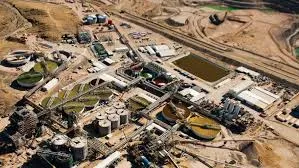
Namibia's mining sector delivered a 25% revenue increase to 64.2 billion Namibian dollars ($3.9 billion) in 2025, outperforming a 9.4% output contraction through price and mix effects — principally record gold prices and a strong uranium production recovery.
The results, published by the Chamber of Mines of Namibia, illustrate the divergence between revenue and volume metrics that has characterised African mining performance across multiple jurisdictions in 2025.
The sector's contribution to state coffers reached 7.8 billion Namibian dollars through taxes, royalties, and export levies, supporting fiscal consolidation in a commodity-dependent economy. Capital investment rose sharply — fixed investment up 31% to 7.46 billion Namibian dollars and exploration spending up 22% to 1.5 billion Namibian dollars — signalling that project-level commitment remains intact despite the activity contraction.
The structural headwinds, however, are not confined to diamond pricing. The chamber's disclosure that Namibia's investment attractiveness ranking declined during 2025 — attributed to policy uncertainty and local ownership requirements — is the more material signal for investors tracking Southern African mining jurisdictions. In an environment where capital is competitive and the DRC, Zambia, and Tanzania are all actively courting foreign mining investment with reform narratives, a declining attractiveness ranking in a comparatively stable jurisdiction requires a policy response if Namibia is to retain its medium-term project pipeline.