The drill rig is where most mining operations begin. Before rock can be blasted, ore can be extracted or a shaft can be sunk, holes must be made in the earth — and that is the job of the mining drill rig. Understanding the different types of drilling equipment, their applications and the key factors in selection is fundamental knowledge for mining engineers, operations managers and procurement teams.
Why drilling is critical to mining
Drilling serves several distinct purposes in mining. In blast hole drilling, rows of holes are drilled into the rock mass and loaded with explosives, allowing large volumes of rock to be fragmented efficiently. In development drilling, holes are drilled at the face of a tunnel or shaft to advance underground workings. In ground support drilling, holes accept rock bolts and cables that stabilise the surrounding rock mass. In exploration drilling, diamond core drill rigs extract cylindrical samples of intact rock from depth to determine the size, grade and geometry of an ore body.
Each of these applications requires a different type of drill rig, with different power systems, feed mechanisms and bit types.
Main types of mining drill rigs
Rotary blast hole drills
Used extensively on surface mines, rotary drills rotate a large bit against the rock face while applying downward thrust. They are the dominant drilling method for large open-pit operations mining copper, iron ore, gold and coal. Modern rotary drills can penetrate 50–100 metres per hour in medium-hard rock and drill holes 150–400mm in diameter. Leading models include the Epiroc PV271, Sandvik DR416i and Caterpillar MD6640.
Top hammer drills
Top hammer drills apply the percussive energy at the top of the drill string — above ground — and transmit it through the drill rods to the bit. They are widely used in surface quarrying, smaller open-pit mines and underground development drilling where hole depths are relatively shallow (typically up to 50–60 metres). Top hammer drilling is faster than rotary in hard rock but has limitations at depth due to energy losses along the drill string.
DTH (down-the-hole) drills
DTH drills address the depth limitation of top hammer drilling by placing the hammer directly behind the bit at the bottom of the hole. This delivers percussive energy more efficiently at depth, making DTH drills well suited to deep blast hole drilling and water well drilling. In mining, DTH is commonly used for blast holes deeper than 30 metres and in medium to hard rock formations.
Longhole drills
Underground longhole drills are designed for stope drilling — creating parallel holes up to 60 metres long that form the blast patterns used in longhole open stoping and sublevel caving. They must be compact enough to operate in limited underground space while delivering the accuracy and penetration rate needed for precise stope geometry. Epiroc and Sandvik both produce market-leading longhole drill models.
Development jumbos
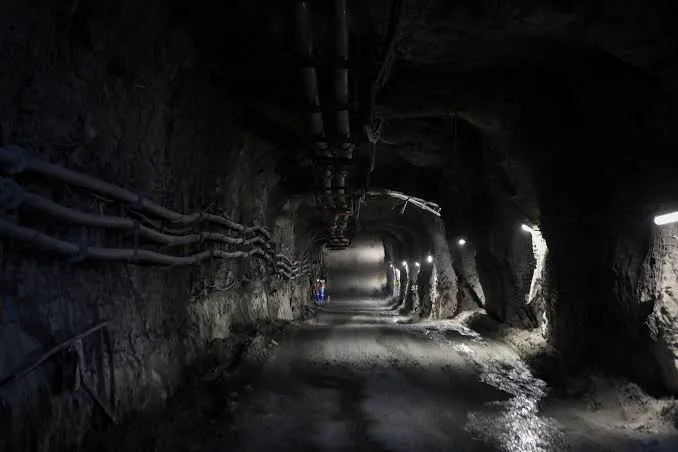
A drill jumbo is a multiple-arm platform used for development drilling underground — advancing tunnels, cross-cuts, declines and shafts through hard rock. Hydraulic booms position rock drills against the face, and the computer-controlled boom guidance systems on modern jumbos can automatically drill complex hole patterns to within millimetres of design specifications. The Sandvik DD421 and Epiroc Boomer series are among the most widely used development jumbos globally.
Diamond core drills
Used primarily in exploration, diamond core drills rotate a diamond-tipped core barrel into rock, extracting intact cylinders (cores) that geologists use to determine rock type, mineralisation and structural characteristics. Core drilling is slower and more expensive per metre than blast hole drilling, but provides irreplaceable geological information. Boart Longyear is the dominant supplier globally, with Atlas Copco and Epiroc also active in this segment.
How to choose the right drill rig for your operation
Rock type and hardness: Hard, abrasive rock such as quartzite or granite requires different bit types, thrust forces and rotation speeds than softer rock. Specify the UCS (unconfined compressive strength) of your rock to suppliers when requesting recommendations.
Required hole depth and diameter: These are the primary technical parameters that determine which drill type is appropriate. Match the drill's rated capacity to your requirements with adequate margin.
Surface or underground application: Underground drills must fit within your tunnel dimensions. Confirm clearance heights, tunnel widths and access constraints before specifying equipment.
OEM service network in your region: In Africa, where service response times matter enormously for uptime, proximity of the OEM's service team and spare parts availability are as important as technical performance. Epiroc, Sandvik and Boart Longyear all maintain regional service networks across major African mining countries.