When people think of mining equipment, they picture trucks, drills and excavators. Conveyors rarely get the same attention — but in many mines, the conveyor system is the single most important piece of infrastructure on site, moving millions of tonnes of material every year with fewer moving parts and lower energy consumption per tonne than any truck fleet could achieve.
Why conveyors are central to mining operations
Conveyors solve a fundamental logistics problem: how do you move enormous quantities of rock continuously, over varying terrain, without the inefficiencies of loading, transporting and tipping individual vehicles? The answer is a belt — a continuous loop of tough rubber compound that carries material from point A to point B at a consistent rate, around the clock, driven by electric motors.
The economic case for conveyors over trucks is well established for long-distance, high-volume haulage. A truck fleet carries material in batches, requires drivers, burns diesel, and has significant operating cost per tonne. A conveyor operates continuously, requires minimal staffing, uses electricity (which can be sourced from renewables), and has a much lower energy cost per tonne moved. For distances over two to three kilometres at sufficient volumes, conveyors almost always win on economics.
Main types of mining conveyors
Overland conveyors
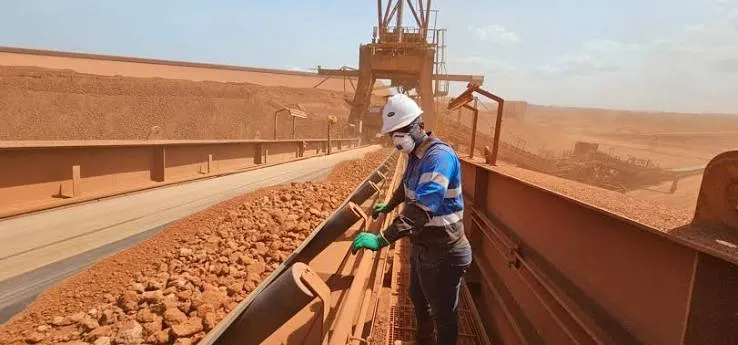
Overland conveyors move ore or waste rock from the mine to a stockpile, processing plant or port over distances that can extend to tens of kilometres. They follow the terrain, with multiple drive stations, transfer towers and take-up systems managing the belt tension across the entire length. The world's longest overland conveyors exceed 100km.
For African mines supplying coastal export terminals — iron ore in West Africa, phosphate in Morocco — overland conveyors are a critical piece of export infrastructure.
Underground conveyors
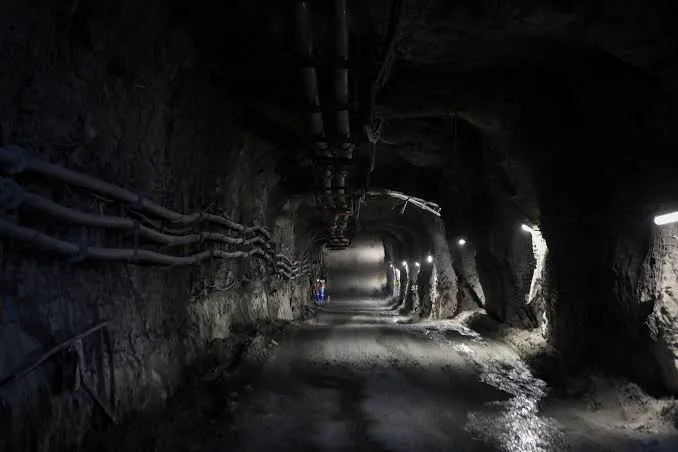
Underground conveyors transport ore from stopes and development faces to ore passes, crushers or hoisting systems. They must navigate curves, steep inclines and confined spaces. Pipe conveyors — which enclose the belt and its load within a tubular structure — are particularly useful in underground applications where conventional troughed belts would create dust or spillage problems.
Stacking and reclaim conveyors
Stockpile management requires conveyors that can stack material across a defined area (stackers) and recover it when needed (reclaim conveyors). These systems allow mines to buffer production against processing fluctuations and build inventory for export or processing.
Feeder conveyors
Short, robust belt feeders extract material from bins, hoppers and stockpile bases at a controlled rate, feeding primary crushers, screens and other processing equipment.
Key components and their failure modes
A conveyor system is only as reliable as its weakest component. Understanding the key components — and their typical failure modes — is essential for maintenance planning.
The belt is the most expensive single component and the one most susceptible to long-term wear and damage. Belt damage from oversize rock, sharp edges, tramp metal and chemical attack are the primary failure mechanisms. Modern conveyor belts incorporate steel cord reinforcement, cut-resistant covers and fire-resistant compounds for underground applications.
Idlers are the rollers that support the loaded belt along its length. Failed idlers can cause belt mistracking, localised wear and, in the worst case, belt fires from friction. Condition monitoring systems that detect failed idlers by vibration or temperature are increasingly standard on major conveyors.
Pulleys drive the belt and control tension at head and tail ends. Pulley failures — particularly shell cracking and bearing failure — cause significant downtime. Regular inspection and planned replacement programmes are essential.
Drive systems consist of electric motors, gearboxes, couplings and variable speed drives. Soft-start capability — critical for avoiding shock loading on long belts at startup — is typically provided by variable frequency drives or fluid couplings.
Leading suppliers for African mining
Continental (formerly Conti-Tech) and Fenner (now part of Michelin) are the dominant conveyor belt suppliers globally, with both having African distribution networks.
Metso and FLSmidth supply conveyor systems as part of broader process plant packages, particularly at greenfield projects.
Bonfiglioli and SEW-Eurodrive are leading suppliers of conveyor drive systems in Africa, with local service networks in South Africa, Ghana, Zambia and beyond.
Conveyors versus trucks: the African context
In Africa, the decision between truck haulage and conveyor systems is influenced by several local factors. Power availability and reliability is critical — a conveyor system without reliable grid power cannot operate. Many African mines use conveyors where power is reliable (near grid connections or with on-site generation) and trucks where power infrastructure is limited or haulage distances are variable.
As renewable energy penetration grows across African mining regions, the economics of electric conveyor haulage over diesel trucks will become increasingly compelling.