The Port of Matadi has been the DRC's principal maritime gateway for over a century. Approximately 150 kilometres up the Congo River from the Atlantic, it is the furthest point navigable by ocean-going vessels before the Livingstone Falls make river passage impossible.
It handles the bulk of the country's containerised imports and general cargo — the machinery, fuel, vehicles, chemicals, food, and manufactured goods that supply Kinshasa and the wider western Congo basin. For as long as the DRC has had an external trade relationship with the world, Matadi has been where that relationship begins.
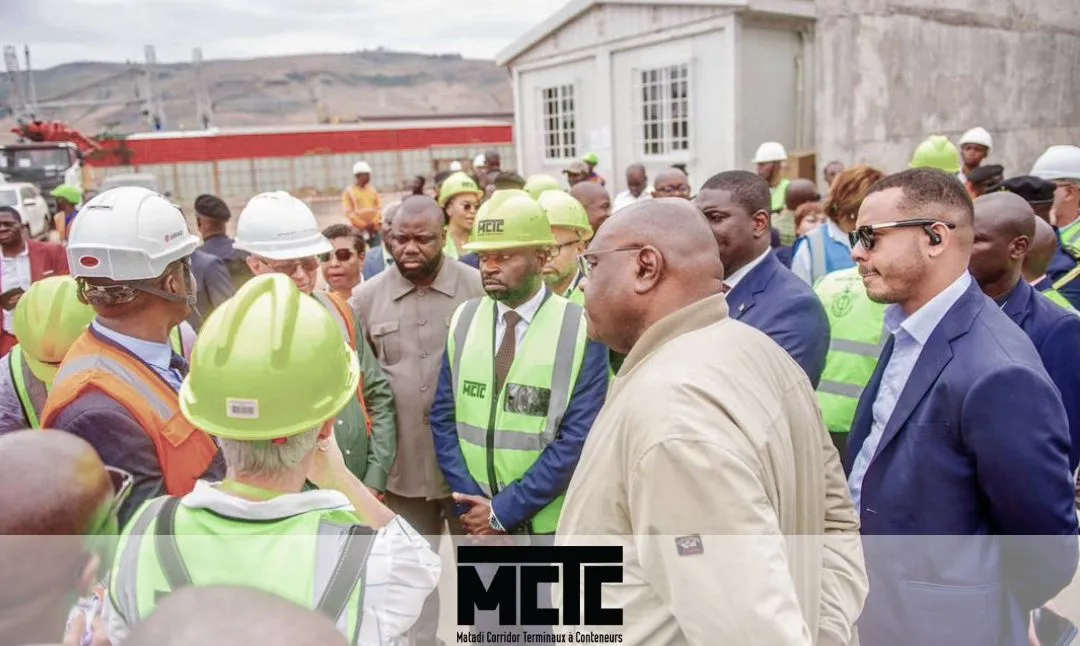
And for most of that time, Matadi has underperformed what the country needed from it. Colonial-era infrastructure. Chronic delays. Container dwell times measured in weeks. A port that visiting Congolese parliamentarians, standing on its own quayside in April 2025 beside new equipment being installed by its new operator, described as "moribund since independence."
The new operator is Matadi Corridor Terminaux à Conteneurs — MCTC.
And what it is building at quais 5, 6, and 7 of the Port of Matadi is not a renovation. It is a complete reconstruction.
What MCTC is
MCTC was created under a public-private partnership framework rooted in a bilateral accord between the Democratic Republic of Congo and the State of Qatar, signed on 10 February 2022, to promote investments in strategic infrastructure. The consortium retained for the project — MSC-SIG, anchored by the Mediterranean Shipping Company — won the concession and established MCTC as the operating entity. The concession runs for an initial period of 20 years, with a possible extension of up to 10 additional years.
The company is chaired by Bodom Matungulu, a civil engineer from the University of Kinshasa's Polytechnic Faculty who holds a master's degree from the École Nationale des Ponts et Chaussées in Paris, specialising in railway systems and urban transport, and a certification from Shanghai Business School in construction and urban planning. Before MCTC, Matungulu served as Technical Advisor for Infrastructure Projects at the Presidency of the Republic of the DRC, where he worked on major PPP infrastructure programmes involving ECCAS, the African Development Bank, the World Bank, and bilateral and multilateral development partners. He is also President of the think tank RDC Strategie and has published two books on the DRC's development trajectory.
The Directeur Général is Christian Ngoy.
Operations began in 2024, when MCTC took over the terminal concession and integrated former ONATRA staff into its workforce — a deliberate continuity decision that preserved the institutional experience of the national transport company's port operators within the new private structure.
MCTC's three service lines are port handling operations — covering all cargo types, containers, bulk, and general merchandise — container storage and management, including real-time tracking; and transfers, customs inspections, and associated logistics services. The company is headquartered at Immeuble Ami Congo, third floor, Matadi, Kongo Central.
What is being built
In January 2025, MCTC awarded the construction contract for the physical transformation of the terminal to Eiffage Génie Civil Marine, the French civil and marine engineering group. The programme represents a total investment of $250 million and a 36-month construction timeline. Works are underway. The port operates throughout.
The infrastructure being built is comprehensive:
A new piled quay on steel piles, extending the terminal's maritime face from 200 to 350 linear metres, is the foundational civil works element.
The existing tablier is being fully demolished and the platform reconstructed. Three passerelles — access bridges of 15 by 19 metres each — are being constructed to link the new quay to the logistics platform and optimise operational flow. Two ducs d'albe and additional access gangways complete the maritime works. Dragging in front of the new quay is included to guarantee optimal vessel draught.
The entire logistics platform — seven hectares of container storage and movement area — is being rehabilitated from the ground up, with a new road structure, a full sanitation and water supply network, an electrical network with transformers and backup generators providing 24/7 power continuity, a fire detection and suppression system to international standards, and a complete drainage and sewage system.
New buildings are being constructed: an operations building and a workshop and spare parts warehouse, both equipped with integrated solar panels for sustainable energy supply. A data centre with high-speed fibre optic infrastructure is included for the digitalisation of port operations. Two rail connections are being installed to link the terminal directly to the Matadi-Kinshasa national rail network. A new perimeter fence with CCTV-equipped gates and portals secures the terminal.
The stated targets: a 40% increase in container handling capacity, a significant reduction in container dwell times and vessel turnaround, 500 direct jobs during the construction phase, and 200 permanent jobs once the terminal reaches operational status.
What this means for investors
For investors reading the DRC, MCTC represents one of the clearest expressions of the country's current infrastructure moment — private international capital, committed at scale, with a long-duration concession structure, at a facility that is strategically irreplaceable.
The 20-year concession underpins the investment logic. No serious operator commits $250 million to port infrastructure on a short-term horizon. The Qatar-DRC bilateral accord, the MSC anchor, the Eiffage construction contract — each of these is a tier-one counterparty making a long-duration commitment to a country they have assessed as viable. For investors building a view on the DRC, that quality of counterparty commitment is material signal.
The 40% capacity expansion is the commercial thesis. Matadi handles the vast majority of the DRC's containerised trade. A 40% increase in handling capacity at the country's primary maritime gateway is not a marginal improvement to a secondary facility. It is a structural expansion of the DRC's trade throughput ceiling. For investors in import-dependent businesses, consumer goods, food processing, manufacturing, construction materials — a faster, higher-capacity Matadi reduces landed costs and supply chain risk. For investors in any DRC sector that imports capital equipment, the same logic applies.
The rail connection being built into the Matadi-Kinshasa national network adds a dimension that is currently absent. An intermodal connection between Matadi's container terminal and the rail corridor running to Kinshasa creates a logistics option — container to rail at the port, rail to Kinshasa's industrial zones — that reduces truck congestion, lowers haulage costs on the corridor, and reduces road degradation. For investors in Kinshasa-based manufacturing or distribution, a functioning Matadi-Kinshasa intermodal connection is a meaningful operational improvement.
The data centre and fibre optic infrastructure included in the project scope signals that MCTC is not building a 1970s-standard port. It is building a digitised terminal with real-time operational management — the kind of infrastructure that integrates into global shipping networks and enables the electronic data interchange that international shippers require.
That digitisation is the difference between a port that global liner services include in their rotation and one they avoid.
What this means for the mining industry
Mining is not what Matadi is primarily for. The DRC's copper and cobalt do not exit through Matadi in meaningful volume, the distances from the Copperbelt to the Congo River's navigable section are too great, and overland routing is more practical for mineral concentrate. But that is precisely why Matadi matters to the mining sector in a way that is underappreciated.
Every significant mining operation in the DRC imports through Matadi.
The mining trucks arrive as project cargo through Matadi. The reagents, lubricants, grinding media, explosives, spare parts, and replacement components that keep a mine running arrive as containerised cargo through Matadi.
The generators, electrical transformers, and substation equipment that power mine sites arrive through Matadi. When Matadi delays, mines feel it — in working capital tied up at the port, in emergency airfreight costs when sea cargo misses its operational window, in the production interruptions that follow reagent shortages. The efficiency of the DRC's import channel is embedded in the economics of every mine in the country, whether or not those mines appear to have anything to do with a port in Kongo Central.
A Matadi that processes containers in days rather than weeks, that has 24/7 power continuity, that has a functioning data centre for electronic pre-clearance, that has a rail connection reducing truck queues at the exit gates, is a Matadi that costs the mining sector less money. Not in a theoretical model — in the actual operational budgets of mines that currently build port-delay contingencies into their procurement planning.
The 200 permanent jobs MCTC expects to create at the terminal after commissioning will be skilled jobs — port equipment operators, logistics technicians, IT and data management personnel, rail operations staff. That workforce development has second-order effects on the wider Kongo Central economy, and on the talent pool available to the logistics and supply chain sector that serves the mining industry.
The solar energy integration is also worth noting in the mining context. Mining companies operating under sustainability-linked finance — and increasingly, that is most of them — track the emissions intensity of their supply chains, including the transport and port handling stages. A solar-powered terminal with low-carbon operations is a better supply-chain partner for mines trying to demonstrate Scope 3 emissions reduction to their lenders and offtakers than a diesel-dependent colonial-era quay.
The company's own statement
MCTC describes its mission as modernising, managing and operating the Matadi container terminal to deliver an efficient, reliable and secure port service for all economic actors. It commits to optimising logistics performance and reducing container processing times; guaranteeing transparency and quality in port operations; contributing to local and national economic development through job creation and workforce training; and promoting sustainable and responsible practices in terminal management.
Its values, as published: safety as an absolute priority, operationalised through strict procedures, regular training, and international port security standards; efficiency and performance through continuous indicator monitoring; integrity and transparency in all decisions and communications; innovation through the adoption of modern technologies and the digitalisation of operations; and sustainability through environmentally responsible practices and local community development.
Its tagline is direct: Moderniser aujourd'hui le corridor de Matadi, connecter demain la RDC au monde. Modernise Matadi today. Connect the DRC to the world tomorrow.
The terminal is under construction. The commitment is 20 years. The investment is $250 million.