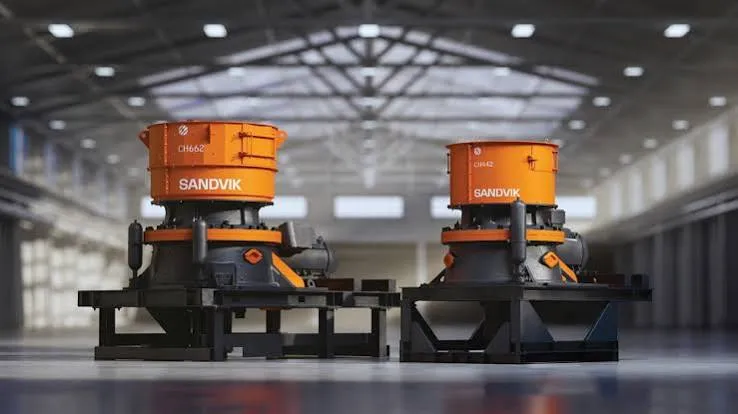
The first African installation of Sandvik’s CH662 cone crusher is notable less for the arrival of a new model than for the decision to purchase two units for a duty that normally requires one.
The crushers are destined for a secondary-crushing application at an underground platinum expansion project in South Africa’s Limpopo province. One will serve as the duty machine and the second as standby capacity.
That configuration carries additional capital cost, but it protects the processing circuit against a critical single-point failure. When a secondary crusher stops, upstream ore movement may have to slow while downstream milling can be starved of correctly sized feed. The financial consequence extends beyond the broken component.
The CH662 is an evolution of Sandvik’s CH660 platform. According to the supplier, mechanical changes include an upgraded top shell, main shaft and spider bushing. A steel-to-steel liner arrangement removes the backing compound traditionally used during liner installation, potentially eliminating as much as 24 hours of curing-related waiting during a change.
The saving should be treated as a maximum supplier estimate rather than a guaranteed reduction at every operation. Actual outage duration will depend on isolation, lifting, inspection, crew readiness and the condition of other components.
The machine also uses Sandvik’s ACS-c 5 ASRi control system for setting regulation, monitoring and remote diagnostics. Digital visibility can allow a specialist to examine trends before travelling to site, but it does not remove the need for sensors, communications, trained technicians and available parts.
Factory acceptance testing was completed in Sweden before shipment. The equipment was ordered through an EPC contractor, which reflects the importance of integrating crusher selection with the flowsheet rather than treating it as a standalone purchase.
For African mines, the broader lesson is that plant capacity should not be assessed only in tonnes per hour. Maintainability, change-out time, standby philosophy and regional support determine how much of that theoretical capacity becomes saleable metal.
Standby philosophy should be based on the whole flowsheet. If stockpiles can provide several hours of buffer, the plant may tolerate a short crusher interruption. If storage is limited, even a minor failure can quickly restrict milling. The value of redundancy therefore depends on plant configuration and recovery time.
Remote diagnostics can shorten the first stage of fault finding, especially when specialists are far from site. It cannot restore production unless the mine has the correct component, safe access and technicians able to complete the repair. Digital capability and physical readiness must be budgeted together.
This installation will become more useful to the market after operating results are available. Buyers need evidence on product-size control, energy use, wear, availability and actual liner-change duration. A first delivery is a technology introduction; sustained performance establishes the business case.
The unnamed project and confidential operating conditions limit conclusions before commissioning. CMN should report the installation as a confirmed equipment deployment, while reserving judgements about productivity and reliability until the operator or supplier publishes comparable operating evidence. Commissioning data will provide the first meaningful benchmark for future purchasing decisions.