Shari Minerals has submitted its first quarterly progress report on the Ituri gold project, but the production target is not yet supported by disclosed figures on investment, plant capacity or mineral resources.
SOKIMO’s partnership with Shari Investment is targeting September 2027 for the start of gold production from a new mining project in Ituri province.
François Kakese Kimaza, chairman of state-owned Société Minière de Kilo-Moto, presented the project’s first quarterly implementation report to Mines Minister Louis Watum Kabamba on September 4.
Project activities began in early June, according to SOKIMO. The development programme includes construction of a gold-processing plant, although its planned capacity, technology and investment cost have not been disclosed.
The project is being carried through Shari Minerals, the corporate vehicle created through the collaboration between SOKIMO and Shari Investment.
Returning Mongbwalu to industrial production
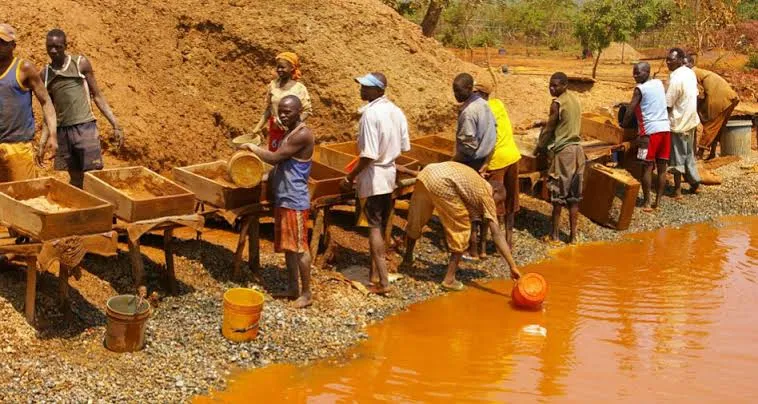
The partnership concerns the Mongbwalu gold concession, one of SOKIMO’s principal assets in Ituri. A contract covering the development and exploitation of the concession was signed earlier in 2026. ACP
For SOKIMO, the arrangement offers another route for converting state-held mining rights into production through private capital and technical participation. The public company has historically controlled extensive gold assets in northeastern DRC but has struggled to finance their development independently.
The first quarterly report indicates that implementation activities are continuing according to the schedule presented by the partners. It does not, however, establish how much construction has been completed or whether the project has reached full financial commitment.
Several elements needed to assess the September 2027 production target remain unavailable. The partners have not published the project’s capital budget, ownership percentages, mineral-resource estimate, planned annual production, expected recovery rate or construction timetable. Details of environmental approvals and community-development arrangements have also not been provided.
The quarterly reporting arrangement gives the Ministry of Mines a mechanism for following execution after the partnership agreement. Its value will depend on whether future reports disclose measurable progress: engineering completed, capital deployed, equipment ordered, construction achieved and permits secured.
At present, Shari Minerals has moved beyond the partnership announcement and into implementation. The September 2027 date remains the partners’ schedule; the technical and financial basis for that schedule has yet to be made public.
Why this ending fits: it records the genuine progress—implementation has started—while separating the partners’ production target from independently verifiable project guidance.