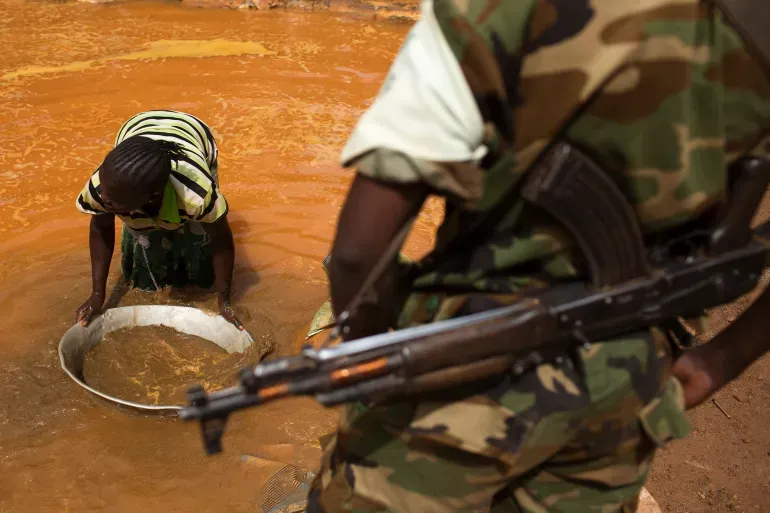
Since 2020, six military coups have swept through Africa's most active gold-mining region — Mali (2020 and 2021), Guinea (2021), Burkina Faso (twice in 2022), and Niger (2023) — fundamentally reshaping the operating environment for gold mining across the Sahel.
The cumulative impact has been: at least nine major mines nationalised or seized; mining codes substantively revised in three countries; significant Russian and Wagner Group involvement in mineral revenue flows; Western mining majors withdrawing from frontier exploration; and a structural increase in West African gold mining risk premiums.
This article maps the coup wave, the mining-specific consequences, and what it means for investors, operators, and African governments.
The Coup Wave: A Timeline
| DateCountryCoup leaderMining impact | |||
| Aug 2020 | Mali | Col. Assimi Goïta (first coup) | Initial regulatory uncertainty |
| May 2021 | Mali | Col. Assimi Goïta (second coup) | Sustained transition |
| Sep 2021 | Guinea | Col. Mamady Doumbouya | Bauxite/Simandou contracts reviewed |
| Jan 2022 | Burkina Faso | Lt. Col. Damiba (first) | Mining sector destabilised |
| Sep 2022 | Burkina Faso | Capt. Ibrahim Traoré (second) | Aggressive resource nationalism |
| Jul 2023 | Niger | Gen. Abdourahamane Tchiani | Orano uranium operations affected |
| Aug 2023 | Gabon | Gen. Brice Oligui Nguema | Manganese sector continues |
Five of these countries — Mali, Burkina Faso, Niger, Guinea, and Gabon — are mining-significant. The pattern is consistent: military officers, often citing security failures and corruption, displace civilian governments and use control of mineral revenues as a tool of consolidation.
What's Driving the Coups: The Mining Connection
The coups share several structural drivers, but mining-specific factors are central:
1. Mineral revenue capture. Gold and other mineral royalties represent significant fiscal flows that previous civilian governments allegedly diverted. Coup leaders position themselves as restoring "national wealth" from corrupt elites and foreign companies.
2. Resource nationalism narrative. All four Sahel coup governments have invoked anti-colonialist, anti-French rhetoric, framing mining renegotiations and nationalisations as restoring sovereignty. France's withdrawal from Mali, Burkina Faso, and Niger has been mirrored by mining contract renegotiations targeting French-aligned operators.
3. Russian and Wagner involvement. The Wagner Group / Africa Corps has provided security services to junta governments in Mali, Burkina Faso, and Niger in exchange for mining concessions and cash payments. Wagner-linked entities now control or operate several gold mines in Mali (M5 mine, Intahaka) and Burkina Faso, generating estimated revenues of hundreds of millions of dollars annually that flow through opaque channels.
4. Security crisis. All four Sahel states face active jihadist insurgencies (JNIM, ISGS) that have destabilised mining regions. Mining companies have responded with armed escorts, retreated supply chains, and in some cases evacuated. The coups partially reflect public frustration with civilian governments' inability to provide security.
Mining-Specific Impact by Country
Mali — The Pioneer of Resource Nationalism (2.0)
Mali's transitional government (under Col. Assimi Goïta) revised the country's mining code in August 2023, with provisions including:
- Increased state free-carried interest: Government share in new mining projects raised from 10% to 30%
- Higher royalties: Gold royalties effectively doubled under certain price scenarios
- Local content quotas: Increased requirements for local procurement and employment
- Profit-sharing mechanisms: New formulas favouring the state during high commodity prices
The 2023 code applied to new mining conventions but the government also pursued retrospective renegotiation of existing conventions. Major operators including Barrick Gold (Loulo-Gounkoto), B2Gold (Fekola), and Resolute Mining (Syama) have faced extended negotiations, periodic operational restrictions, and significant tax disputes.
In November 2024, Resolute Mining's CEO and two senior staff were detained in Bamako for several days during a tax dispute — settled with a $160 million payment to the government. The incident sent a chilling signal to the international mining community.
Wagner connections: Russian state-linked entities operate the small-scale Intahaka gold mine and reportedly receive direct gold payments from informal artisanal mining operations across northern Mali in exchange for security services to the junta.
Burkina Faso — Aggressive Nationalisation
Capt. Ibrahim Traoré's transitional government (since September 2022) has been the most aggressive among Sahel juntas in pursuing resource nationalism in the gold sector:
- 2023: Endeavour Mining's Wahgnion and Boungou mines were effectively nationalised, with operating licences cancelled and the assets transferred to the state via SOPAMIB (a state mining entity)
- 2024–2025: Multiple junior exploration permits cancelled; mining royalties increased
- April 2025: Nordgold's Niou licence was renewed but with new state participation and royalty terms
- Russian Africa Corps (formerly Wagner) provides direct military support to the junta and reportedly receives mineral revenue payments
Operators continuing: IAMGOLD (Essakane), West African Resources (Sanbrado + Kiaka), Orezone (Bomboré), Nordgold (Bissa-Bouly) — though all face higher operating risk and royalty pressure. Endeavour Mining (formerly the dominant operator) has been substantially reduced.
Guinea — Bauxite, Iron Ore, and Junta-Era Renegotiations
Guinea's coup (September 2021) under Col. Mamady Doumbouya was less mining-disruptive than the Sahel coups, partly because Guinea was already in resource renegotiation mode. The junta has:
- Reviewed and partially renegotiated the Simandou iron ore framework (resulting in the December 2025 first shipment under restructured ownership)
- Increased state involvement in bauxite contracts via SBM/Société des Bauxites de Mamou
- Pursued domestic refining ambitions (alumina refining in-country)
- Maintained openness to Chinese investment (SMB-Winning is a major operator)
Guinea is structurally important enough — particularly to China for bauxite supply — that the junta has had economic incentive to maintain operational stability in the mining sector. The contrast with the Sahel coups is instructive.
Niger — Uranium and the French Pivot
The July 2023 coup in Niger had immediate and dramatic mining consequences. Niger was historically France's most important uranium supplier (via Orano's Arlit and Imouraren operations), supplying approximately 30% of French civilian nuclear fuel. Following the coup:
- Orano's licences were partially suspended and uranium exports through traditional French channels were disrupted
- Russia's Rosatom signed preliminary uranium agreements with the Niger junta
- France formally withdrew its diplomatic presence and military forces from Niger in 2024
- Niger has explored uranium offtake agreements with China and other non-Western buyers
The strategic implications extend well beyond Niger — France's nuclear fuel supply diversification and the broader uranium market have been significantly impacted.
Gabon — A Different Kind of Coup
The August 2023 coup in Gabon (General Brice Oligui Nguema, ousting President Ali Bongo after 14 years) has not followed the Sahel pattern. Mining operations — primarily manganese (Comilog/Eramet) and iron ore (Fortescue/Ivindo Iron) — have continued largely uninterrupted. The transitional government has maintained openness to foreign mining investment as Gabon transitions away from oil dependency.
This suggests not all African coups produce identical mining-sector outcomes — country context, commodity, and operator profile all matter.
The Wagner / Africa Corps Mining Footprint
Russia's Wagner Group (rebranded to Africa Corps following Yevgeny Prigozhin's death in 2023) has built a significant mineral revenue footprint across the Sahel:
- Mali: Wagner operates from the Joliba military base near Bamako; gold mining operations linked to Wagner include the Intahaka mine and informal artisanal operations across northern Mali
- Central African Republic: Wagner-linked Lobaye Invest holds gold and diamond concessions
- Burkina Faso: Direct payments from junta to Africa Corps reportedly include mineral revenue allocations
- Sudan: Wagner-linked entities operated gold mining (now contested in the ongoing civil war)
Estimated annual mineral revenues to Wagner / Africa Corps from African operations: $200–500 million (US Treasury and CSIS estimates). The US Treasury sanctioned multiple Wagner-linked mining entities in 2023 and 2024.
Implications for Investors and Operators
Higher risk premiums. West African gold mining has long carried elevated risk premiums vs Australian or Canadian operations (typically 200–400 basis points). Post-coup Sahel premiums have widened significantly, with several junior explorers losing access to capital markets entirely.
Withdrawal of Western majors. Newmont, Gold Fields, AngloGold Ashanti — all of which historically explored West Africa — have substantially reduced exploration commitments in the Sahel. The risk-adjusted returns no longer justify the exposure for major-cap public companies.
Mid-tier operators carry on. Companies including B2Gold, Endeavour Mining, IAMGOLD, West African Resources, Orezone, Allied Gold continue operating but with elevated risk management costs (security, government relations, contingency capital).
Junior exploration collapse. The pre-2020 ecosystem of TSX-V and ASX-listed junior explorers in the Sahel has substantially contracted. Few new permits are being granted; existing exploration projects are being deferred or abandoned.
Russian and Chinese opportunism. Where Western capital withdraws, Russian and Chinese companies have selectively entered. Russia's Nordgold (US-sanctioned) operates through proxy structures; Chinese juniors are increasingly active in DRC and Tanzania (which are not Sahel-coup affected).
Stable jurisdictions benefit. Côte d'Ivoire, Ghana, and Tanzania have benefited from capital reallocation away from the Sahel. Côte d'Ivoire in particular has become the preferred West African gold jurisdiction for risk-conscious capital.
The Path Forward: 2026–2030
Several scenarios bear watching:
1. Mali / Burkina Faso / Niger normalisation. Whether the junta governments transition to elected governments — and whether mining contracts renegotiated under junta administrations are honoured by successor governments — will determine the medium-term trajectory.
2. Ongoing Russian / Wagner involvement. The financial dependence of Sahel juntas on Russian security services makes near-term withdrawal of Russian mineral interests unlikely, even with shifting Russian strategic priorities.
3. ECOWAS reintegration. The withdrawal of Mali, Burkina Faso, and Niger from ECOWAS (2024) and creation of the Sahel States Confederation (Alliance des États du Sahel) has fragmented West African economic integration. Mining companies operating across multiple countries face increasing complexity.
4. New investment cycles. Some Western capital may return as long-term gold prices remain elevated and Sahel security situations stabilise. Endeavour Mining's continued Burkina Faso operations and IAMGOLD's Essakane investment indicate that profitable operations can continue even under junta administrations.
5. The next coup risk. Several West and Central African states (Senegal, Cameroon, etc.) face succession or governance challenges. Mining operators routinely model coup risk in country risk analyses post-2022.
Frequently Asked Questions
How many mining coups have happened in Africa since 2020? Six successful coups have occurred in mining-significant African countries since 2020: Mali (twice — August 2020 and May 2021), Guinea (September 2021), Burkina Faso (twice — January 2022 and September 2022), Niger (July 2023), and Gabon (August 2023). Several attempted coups have also occurred.
Which African country has nationalised the most mines? Burkina Faso has been the most aggressive nationaliser since its 2022 coups. The Wahgnion and Boungou mines (formerly Endeavour Mining) were transferred to state control via SOPAMIB. Multiple junior exploration licences have been cancelled. Mining royalties have been increased.
Is Mali still safe for mining investment? Mali remains operationally functional for established mining majors (Barrick, B2Gold, Resolute) but operating costs and political risks have increased materially since the 2020–2021 coups and the 2023 mining code revision. The detention of Resolute Mining executives in 2024 signalled tighter operating conditions.
What is the Wagner Group's role in African mining? Wagner Group (now Africa Corps) provides military security services to several junta-led African governments — primarily Mali, Burkina Faso, and previously the Central African Republic and Sudan. In exchange, Wagner-linked entities have received gold and diamond mining concessions, direct payments from artisanal mining operations, and mineral revenue allocations from junta governments. US Treasury estimates Wagner's annual African mineral revenues at $200–500 million.
Are Western mining companies still investing in West Africa? Yes, but more selectively. Côte d'Ivoire and Ghana remain attractive destinations. The Sahel (Mali, Burkina Faso, Niger) has seen substantial Western disengagement, with juniors particularly affected. Mid-tier operators with established Sahel operations generally continue but with elevated risk management costs.
Sources: African Center for Strategic Studies coup database; CSIS Africa Program coup analysis 2023–2025; US Treasury OFAC Wagner Group sanctions designations; Crisis Group Sahel reports 2023–2025; Endeavour Mining ASX announcements; Resolute Mining 2024 settlement disclosures; Burkina Faso Ministry of Mines press releases; Mali Ministry of Mines mining code documentation.
Last updated: May 2026.