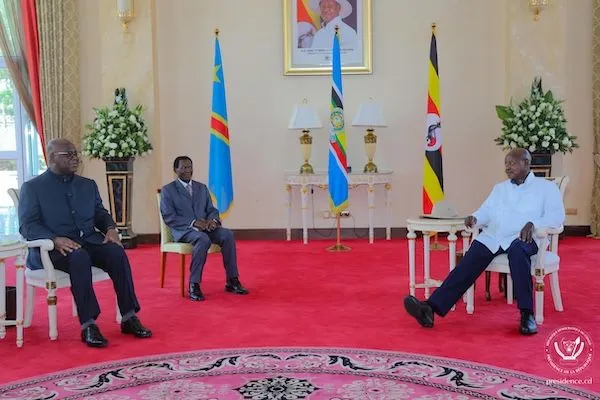
The Democratic Republic of Congo and Uganda formalised six bilateral agreements in Kampala on May 11, 2026, covering Standard Gauge Railway connectivity, one-stop border posts, mineral certification, energy interconnection, and trade facilitation — moves that directly affect supply chain access for mining operators in eastern DRC.
Uganda is now the DRC's largest export market, with bilateral trade growing 29% over two years to surpass $962 million in fiscal 2024-2025, putting the bilateral relationship within reach of the symbolic $1 billion threshold. Infrastructure driving that trade includes the Kasindi-Beni road at 60% completion and the Beni-Butembo corridor at 6%, both critical arteries for mineral and commodity flows from the eastern Copperbelt to regional markets.
The launch of a joint certification mechanism for conflict-free minerals is the most commercially significant outcome for investors: it creates a bilateral framework for tracing mineral origin across one of Sub-Saharan Africa's most active informal trading corridors, where gold, coltan, and cassiterite have historically moved outside formal supply chains. Progress on the Ruzizi III Hydropower Project and Goma electricity interconnection adds an energy dimension directly relevant to mining operators managing power costs in North Kivu and South Kivu.
Both governments adopted a Matrix of Priority Actions with strict implementation timelines, providing investors with a monitoring framework — though execution against prior JPC commitments has been uneven